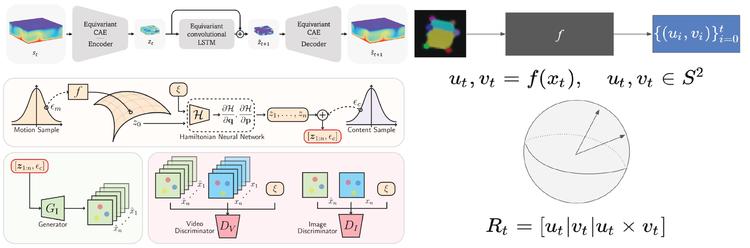
Geometric Deep Learning Architectures
Many learning problems possess underlying geometric and topological structures that conventional neural networks do not explicitly respect. Without mechanisms to preserve these structures, models may require extensive training data and struggle to generalize across transformations and structured domains.
Our research develops neural architectures grounded in symmetry, geometric algebra, differential geometry, and algebraic topology. We design representations and operators that enforce specified mathematical properties by construction, including equivariance and compatibility with discrete geometric operators. We investigate how these architectural guarantees influence expressivity, computational efficiency, and generalization, with applications spanning computer vision, scientific computing, and robotics.
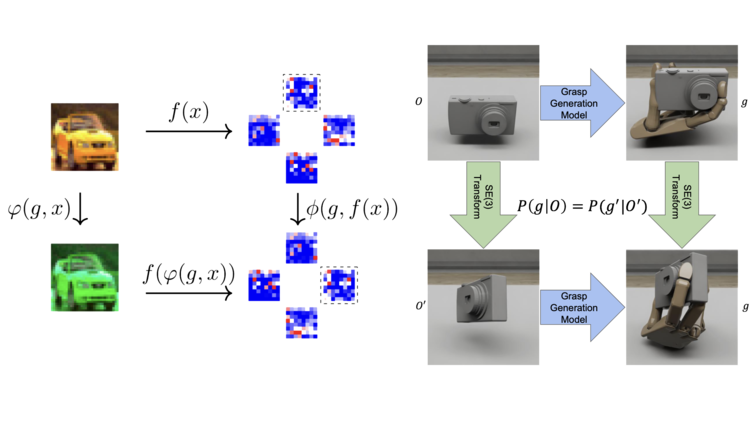
Geometric Deep Learning for Robotics
Robotic learning problems are shaped by spatial relationships, physical embodiments, and interactions between agents and their environments. Conventional learning methods often fail to exploit this structure, requiring extensive training data and struggling to generalize across tasks, environments, and robotic configurations.
Our research develops geometric learning methods for robotic manipulation, navigation, and multi-agent coordination. We investigate how geometric representations, equivariant architectures, and structured interaction models can be integrated with reinforcement learning and generative modeling to improve policy learning and transfer. Through this work, we seek to develop data-efficient, robust, and generalizable robotic policies that adapt to new tasks, environments, and physical embodiments.
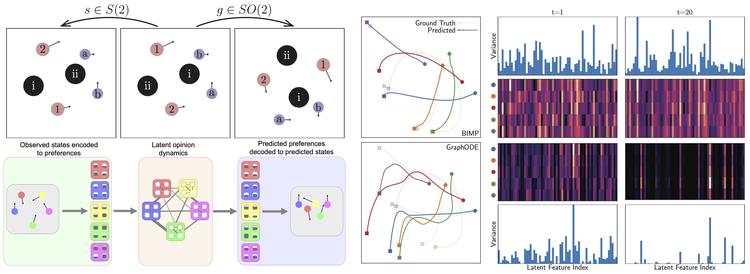
Geometric Deep Learning for Science
Physical systems exhibit geometric and dynamical structure, including symmetries, conservation laws, and relationships among quantities defined over space and time. Conventional data-driven models often fail to account for this structure, limiting their ability to capture complex dynamics, infer hidden properties, and generalize beyond observed conditions.
Our research develops geometric and physics-guided learning methods for modeling and understanding physical systems. We combine structured representations, Hamiltonian and generative dynamics models, geometric neural operators, and differentiable simulation to learn complex dynamics, discover interpretable physical structure, and solve inverse problems. Through this work, we investigate how incorporating mathematical and physical principles can improve predictive accuracy, data efficiency, physical consistency, and generalization.